


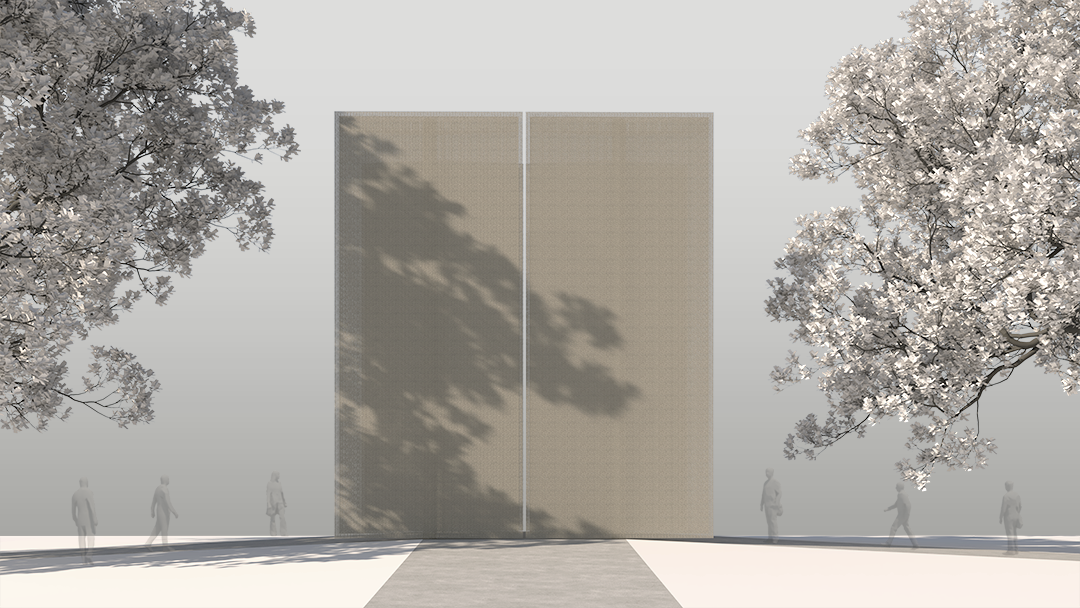


THE CROSSING
PROJECT INFO
LOS ANGELES, CA
INSTALLATION
The Crossing is a self-reflective art installation that stages an encounter between a large kinetic sculpture and its visitors in a hypothetical public space. The abstract, invisible rules of access to it manifest in the changing physical presence of the work itself, and this inherent spatial instability confronts visitors with alternating experiences of inclusion and exclusion.
The installation and its choreographed behavior thus act like a law-making and enforcing apparatus that slowly and gently manipulates spatial hierarchies to either welcome or straight-out reject visitors, depending on which direction they are coming from. The Crossing is a device for making its own invisible access protocol present and perceptible, disclosing itself to its visitors, and giving them an opportunity to reflect on the purposes and workings of this public space.
Upon approach, The Crossing appears as a kinetic structure large enough to evoke public significance and function as a moving stage set. People can experience it as spectators from the outside or as actors on the inside. The presence of other visitors in this theatrical setting produces an empathic resonance between them all and suggests that they are each playing a role in which their encounters, experiences and emotions matter to each other.
The terrain rises gently to a square where four paths meet at right angles, forming an intersection oriented towards the cardinal directions. At each corner of this open-air stage stands a tall pivoting door, four of them in total, cycling continuously through a full rotation at an imperceptibly slow pace, like the hands of a timeless clock. Each pair of doors acts as a portal for anyone traveling along either path. Their slow choreography creates an ever-changing series of spatial configurations, opening and closing the access to the square from each of the four directions of arrival to varying degrees throughout time.
The four doors never entirely open the full width of either one path without walling off another. The changing door positions in relation to each other frame the space of the visitors’ encounters, allowing or blocking their motion along each path, and causing their momentary inclusion or exclusion from the shared space of the square.
Because the doors are perpetually moving, no configuration is permanent. Visitors arriving at the intersection find a spatial arrangement that differs from the one that preceded it and will differ from the one that follows. The right of passage manifests anew in each current configuration at each moment. The place resists habituation to its workings and appearance.
Within its single recognizable form, The Crossing generates a variety of spatial types: an enclosed square, a ceremonial threshold, an open intersection, a walled passage. Each of these configurations can host its own kind of ritual or encounter. The monument presents an iconic unity from a distance but a multiplicity of spatial identities within it.